
Key takeaways
- Mid-tone blends with dark, medium and light chips hide the most dirt. Near-black floors show dust and road salt; near-white floors show mud and tire marks.
- Light changes the floor: cool tubes pull a blend toward gray and blue, warm bulbs and late sun toward tan, and shade makes any blend read darker.
- A chip in the hand shows the colors in a blend, not how they add up across a two-car slab, where high-contrast chips merge into one overall tone.
- On a partial broadcast the base coat shows between the chips, so pick the base and the blend as a pair.
- Start from what will not change (cabinets, walls, the house, the car), narrow to two or three blends on their own photo, and confirm with a chip.
The short version
How to choose epoxy flake colors, in the order that works
Choose in this order: what the floor has to hide, the light it lives in, what it sits beside, and how much flake goes down. Only then open the chart.
Homeowners often start the other way round. They fall for a chip and ask you to price it, and that chip may be the wrong tone for a garage that sees mud all winter. Put the practical questions first, so the one they love also works.
01
Ask what it has to hide.
Mud, road salt, sawdust, leaves, a car that comes in hot off the highway. The answer sets how light or dark the floor can go.
02
Look at the light.
Ceiling tubes, LED shop lights, an open door all afternoon, full sun on a deck.
03
Start from what will not change.
Cabinets, walls, the house, the coping, the car. Pick warm or cool to suit them.
04
Settle full or partial broadcast.
On a partial broadcast the base coat is part of the color.
05
Shortlist on their own photo, then confirm with a chip.
Preview two or three blends on their slab in about 15 seconds each, then bring the finalists to the visit.
Dirt and tire marks
Which flake colors hide dirt and tire marks
Mid-tone blends with dark, medium and light chips hide the most. Dust, grit, water spots and the odd tire mark land on a busy mid-tone and disappear. Very dark and very light floors both show dirt; they just show different dirt.
A near-black floor shows everything light: dust, pollen, sawdust and dried road salt. A near-white floor shows everything dark: mud, rust, oil drips and tire marks. Hot tires can leave brownish marks on a coated floor, and on a light one nobody misses them.
| Floor tone | Hides | Shows | Default catalog blends |
|---|---|---|---|
| Very dark, mostly black chips | Tire marks, oil, dark grime | Dust, pollen, dried road salt, footprints | Raven |
| Mid-tone gray, several chip colors | Most everyday dirt and light tire marks | Little until it needs a mop | Gravel, Domino, Tidal Wave |
| Mid-tone warm, tan and brown chips | Sand, red clay, leaves, dust | Little until it needs a mop | Shoreline, Outback |
| Very light gray, white or cream | Light dust | Tire marks, mud, rust, oil drips | Husky, Sandstone, Blizzard |
Blend names are from the default catalog. Your own catalog shows the blends you install, under your supplier's names.
The best flake color for a garage floor that gets used
There is no single best flake color for a garage floor, but for a working garage the safe pick is a mid-tone blend with dark, medium and light chips, in gray or tan to suit the house. Save near-white and near-black for the show garage that gets wiped down, and say why before the homeowner falls for one.

Gravel, a mid-tone gray, on a contractor's patio job photo. An illustrative AI preview, not a photo of an installed floor. 
Shoreline, a warm tan, on the same patio. An illustrative AI preview, not a photo of an installed floor. 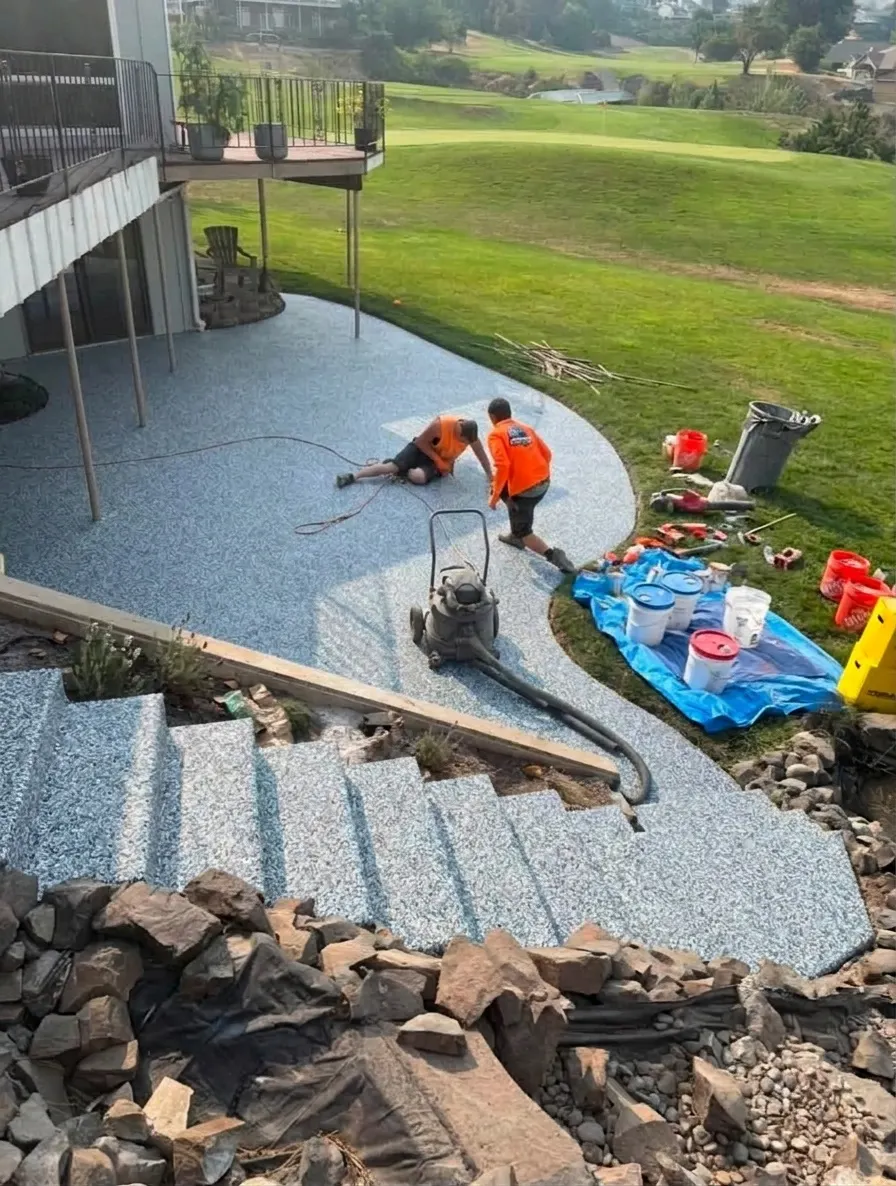
Blizzard, a light blend: bright, and quicker to show dirt. An illustrative AI preview, not a photo of an installed floor.


Lighting
Garage LEDs, daylight and shade change how a blend reads
Judge a blend in the light it will live in. Cool light pulls a floor toward gray and blue, warm light toward tan and yellow, and shade makes any blend read darker. A tan blend that looked warm in the driveway can go flat and gray under a ceiling of cool tubes.
Lower color temperatures mean warmer, yellower light and higher ones cooler, bluer light, as the ENERGY STAR bulb guide puts it. The Department of Energy puts typical incandescent bulbs around 2,700 K and office fluorescent lamps around 4,100 K. One garage can hold both, plus daylight through the open door.
- Look with the door down, then up. Hold the chip on the slab under their own lights first. If it only works in one light, keep looking.
- Ask about new lights. If they plan to change the fixtures, judge the color under the new ones.
- Mind the shade line. Under a deck or a carport, a dark blend can read almost black while the sunny half reads mid-gray.

The preview keeps the light of the photo it is given, so ask for the photo in the light that matters: the garage with the lights on at the hour they use it. These garage photo tips for the preview cover the rest.
Scale
Why a chip in the hand misleads at slab scale
A chip shows the colors in a blend; it cannot show how they add up across a two-car slab. At arm's length you see single flakes. From the doorway the eye blends them into one tone, roughly the average of the chips, and that average is what the homeowner lives with.
High-contrast blends calm down at scale: stark black and white chips read as salt-and-pepper gray. Small accent chips either vanish or tint the whole floor, and a chip in the hand will not tell you which.
Chip size moves the read too. A finer chip merges into one tone sooner, and a bigger chip keeps its speckle from farther back. The default catalog previews one standard chip size, so confirm a finer chip on a sample board.
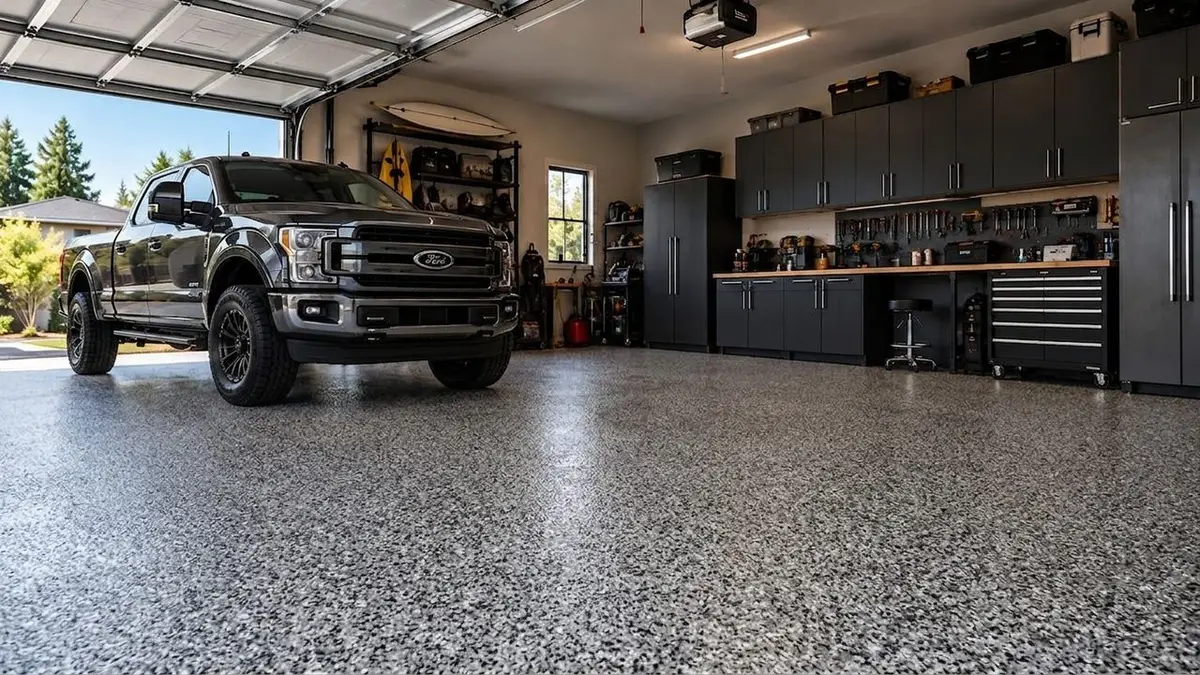
Domino across the demo garage. An illustrative AI preview, not a photo of an installed floor. 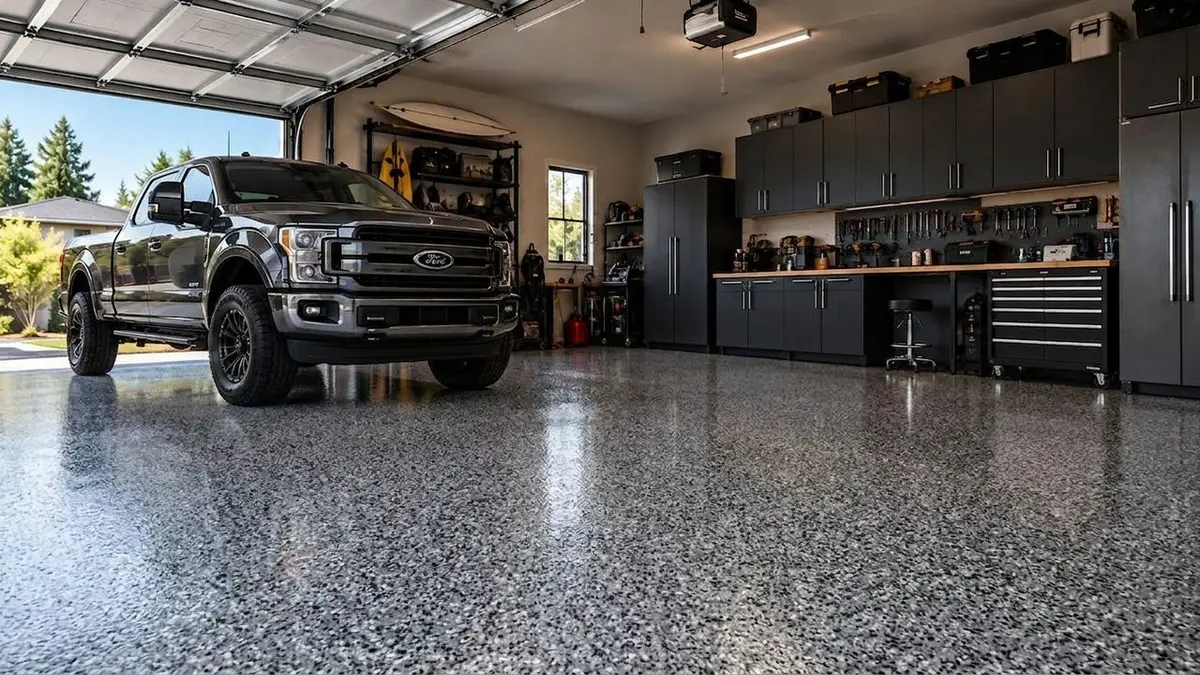
Nightfall in the same garage. An illustrative AI preview, not a photo of an installed floor.


On the finish chart, Domino is stark black, white and gray, and Nightfall is darker grays with blue-gray chips. They look like two different floors. Across the demo garage they read as close cousins, so a homeowner who has seen both on a whole slab can stop agonizing and pick on cabinets and light instead.
Full or partial
Full broadcast vs partial broadcast: how each one reads
On a full broadcast the floor is all flake, so the blend is the color. On a partial broadcast the base coat shows between the chips and becomes part of the floor, often the biggest part. Settle which one you are quoting before the color talk.
| Question | Full broadcast | Partial broadcast |
|---|---|---|
| What sets the color | The blend | The base coat first, the blend second |
| What they choose | One blend | A base color and a blend that suit each other |
| How it reads from the doorway | The average of the chips | Toward the base color, with speckle |
| How it handles dirt | Like the blend | Like the base: a light base shows dirt like a light solid floor |
| How to show it | A flake preview on their photo | A sample board at the real density, over your base coat |
On a partial broadcast, pair the base with the main tone of the blend, so the gaps between chips sink into the floor instead of jumping out. These are starting points to check on a board.
| Blend | Base to try first | Why |
|---|---|---|
| Gray with black and white chips (Gravel, Domino) | Medium gray | The gaps disappear into the main tone |
| Warm tan and brown (Shoreline, Outback) | Tan or light brown | A gray base under warm chips reads cold |
| Gray with blue-gray chips (Tidal Wave, Nightfall) | Medium or dark gray | The blue stays an accent |
| Very light (Husky, Blizzard) | Light gray | A dark base turns every gap into a dark spot |
Make the board at the density you will actually throw, with your own base coat.
The visualizer's default catalog previews flake at full coverage under a glossy topcoat. If you sell partial broadcast, use the flake preview for color direction, preview the base as a solid color on the same photo, and bring the board to the visit.
The house
Matching the house, the cabinets, the walls and the car
Start from what will not change. Cabinets, walls, the garage door, the siding you see with the door up, and the car that parks there are all staying. Pick a warm or cool direction that suits them, then the depth, then the blend.
- Warm or cool first. Gray, white and blue chips sit well with white, gray and black finishes. Tan, brown and cream chips sit well with wood, beige walls and brick.
- Then contrast. Black cabinets disappear into a near-black floor and stand out on a mid-gray one. White cabinets do the opposite.
- Check the view with the door up. The floor reads against the driveway, the siding and the trim.
- Ask what parks there. A mid-tone floor flatters almost any paint. A floor the same tone as the car makes the car disappear.
Garage floor flake color ideas to start from
| If the garage has | Start with | Default catalog blends to try |
|---|---|---|
| Black or charcoal cabinets, white or gray walls | A mid-gray blend with white chips | Gravel, Domino |
| Wood cabinets, beige walls, brick | A warm tan and brown blend, or a cream one for a lighter floor | Shoreline, Outback, Coyote |
| Blue trim, a coastal or modern house | A gray blend with blue-gray chips | Tidal Wave, Nightfall |
| A shop that sees grease, mud and sawdust | A darker mid-tone with plenty of contrast | Gravel, Nightfall |
| A bold color they love, like blue | A bold blend, previewed on their floor before anyone commits | Orbit |
Starting points, not rules. Your own catalog swaps in the blends you install.
Metallic floors follow the same logic with higher stakes, because there is no chip pattern to hide behind: see how to pick metallic epoxy colors.
Patios and pool decks
Patios and pool decks: heat and glare are buying questions
Outdoors the same rules apply, plus two questions no chart or preview answers: how hot will it get under bare feet, and how much will it glare? Answer both from your system and your site visit, not from the picture.
The EPA counts paving that reflects more solar energy among the cool pavements it describes, materials that stay cooler than conventional paving (EPA on cool pavements). A lighter blend reflects more sun than a dark one, which is a reason to put one on the shortlist for an open deck. The trade-off is brightness, so ask which way the deck faces and when they use it, and settle the topcoat and texture at the visit.
- Start from the hardscape. Coping, pool tile, pavers and stone walls are fixed. Warm stone wants a warm blend; gray coping wants gray.
- Run one light and one mid-tone. The lighter one reflects more sun; the mid-tone hides leaves, pollen and clippings better.
- Match the steps and walkways to the deck they lead to.

Broadcast quartz is common on pool decks too, so preview quartz beside flake on the same deck. Slip, UV and the other outdoor questions are on the patio and pool deck visualizer page.
Settle it
How a preview on their own photo settles the choice
Narrow the chart to two or three blends, then show each on a photo of the homeowner's own floor. With CoatFlow on your website, they take the photo, tap a blend and see it across their slab in about 15 seconds, with their walls, cabinets, car and light left in the picture.


01
Preview each finalist on their photo.
One photo credit is one preview. No photo yet? The built-in garage, patio and pool deck demo rooms show every finish.
02
Put the finalists side by side.
With Compare view on, two to four previews of the same floor line up together, in the same light.
03
Send it to whoever was not home.
They can save or share the preview, so the second decision maker votes on their own garage, not on your description of a chip. A short walkthrough clip of the favorite helps too. It takes a few minutes to film and is an illustrative AI video of the preview, not footage of an installed floor.
04
Confirm with the chip at the visit.
Hold the finalists on the slab in daylight and write the blend on the quote.
Your widget shows the blends you install, under your supplier's names: send us your color charts and our team sets up your catalog, with no setup fee. Until then it shows the default catalog in flake, metallic, quartz and solid color. See flake previews on garages, patios and pool decks, and the epoxy floor selling playbook for the rest of the sale.
See a blend on a real slab
Upload a photo of any garage, patio or pool deck, or tap a demo room, and see a flake blend on it in about 15 seconds.
Sources
Figures from other companies and publishers are quoted as their pages stated them on October 6, 2026. Prices change; check the source before you rely on one.